Senior Dog Enrichment: Keeping Aging Dogs Sharp, Happy, and Engaged
Share
There is a particular kind of love that comes with a gray muzzle. You know your dog's rhythms, their quirks, the way they sigh when they finally settle at your feet. And even as their pace slows, their need for connection, stimulation, and purpose never disappears. For senior dogs, thoughtful enrichment may be one of the most important gifts you can give — not just for their happiness, but for their brain.
Younger dogs often burn off energy and stimulate their minds through vigorous play, long runs, and demanding games. Senior dogs frequently deal with joint pain or arthritis, a slower metabolism, and some degree of cognitive decline, all while their overall stamina decreases. That does not mean their need for mental stimulation goes away — if anything, it becomes more important. The challenge for pet parents is finding enrichment that respects an aging body while still feeding an active mind.
Understanding Cognitive Aging in Dogs
What Is Canine Cognitive Dysfunction (CCD)?
Dogs age cognitively, just as humans do. The condition veterinarians call Canine Cognitive Dysfunction (CCD) is the dog equivalent of dementia or Alzheimer's disease. It's a progressive neurodegenerative condition that affects memory, learning, awareness, and behavior.
According to research reviewed by Wilson's Health, 35% of dogs over eight years old show signs of cognitive decline, and more than 60% of dogs over eleven display at least one symptom consistent with canine dementia.
Signs of Cognitive Decline in Senior Dogs
The signs of CCD follow a recognizable pattern, often abbreviated as DISHA:
- Disorientation — getting stuck in corners, staring at walls, appearing confused in familiar spaces
- Interaction changes — less interest in family members or other pets
- Sleep-wake cycle changes — restlessness at night, increased daytime sleeping
- Housetraining lapses — accidents in dogs with previously reliable habits
- Activity changes — decreased interest in play, exploration, or former favorite activities
VCA Animal Hospitals outlines the full diagnostic process for owners who want to understand what to expect.
The Biology: Why Aging Brains Need Stimulation
Research published in PMC has shown that enriched environments — those with novel stimuli, sensory engagement, and problem-solving opportunities — can maintain neuroplasticity and slow the progression of cognitive decline. In practical terms: using your senior dog's brain helps protect it. Veterinary behaviorists generally agree that this kind of mental stimulation cannot reverse or cure cognitive decline, but it can meaningfully support quality of life for years to come.
There's a practical side to this too: physical exercise options shrink as dogs age. A dog with arthritis or hip dysplasia simply cannot run and jump the way it once did, and pushing a painful body too hard can cause setbacks or injury. Mental enrichment fills that gap — a ten-minute lick mat session or a slow sniff around the yard does not stress aging joints, yet it still delivers the same kind of mental "workout" a young dog gets from chasing a ball, just in a much gentler package.
Cooking for an older dog?
The free SodaPup Bowl Builder adjusts calories for seniors, grades the recipe against AAFCO nutrient profiles, and shows it served in a SodaPup slow feeder.
Build my dog's bowl →How it worksThe Challenge: Enriching an Aging Body
Arthritis and Joint Pain
Cornell University College of Veterinary Medicine estimates that up to 80% of dogs over eight years old have some degree of osteoarthritis. Enrichment for arthritic seniors must prioritize positions that reduce joint stress.
Sensory Changes
Many senior dogs experience declining vision and/or hearing. Scent-based activities, however, typically remain fully accessible — a dog's sense of smell is remarkably resilient to aging.
Stamina and Fatigue
Senior dogs tire more quickly than their younger selves, both physically and mentally. Five to fifteen minutes of focused enrichment is often more effective than a long, drawn-out session that leaves an older dog frustrated or exhausted. Short, successful sessions are the goal; never push a senior dog to the point of frustration or fatigue.
Dental Sensitivity
Older dogs often have dental disease, worn teeth, or post-extraction sensitivity. Enrichment choices should prioritize soft-surface, licking-based activities over hard chewing.
Bloat Risk
Gastric dilatation-volvulus, commonly known as bloat, is a serious and potentially life-threatening condition in which the stomach fills with gas and can twist on itself. Dogs that eat quickly are at higher risk, and older dogs — particularly larger and deep-chested breeds — face an elevated risk profile compared to younger dogs. Slowing down the pace of eating with a slow feeder is one of the simplest, most effective ways to reduce that risk. For what the research actually shows, read do slow feeders prevent bloat in dogs?
The Best Enrichment Activities for Senior Dogs
1. Lick Mats: The Gold Standard for Senior Enrichment
If there is one enrichment tool purpose-built for senior dogs, it is the lick mat. Licking is a low-impact, repetitive, self-soothing behavior that veterinarians widely recommend for its calming effects — it has been associated with the release of calming neurochemicals and a reduction in stress-related cortisol levels, which is part of why so many dogs seem to settle down after a licking session. For seniors, licking:
- Requires no jumping or physical exertion
- Can be performed lying down, reducing joint stress
- Provides cognitive engagement through texture and flavor variation
- Is accessible even to dogs with limited vision or hearing
- Supports dental hygiene when used with appropriate fillings
The SodaPup eMat is made in the USA from non-toxic, food-safe materials and features a flat-profile design that older dogs can engage with comfortably from a lying or standing position. Many designs include suction cups that hold the mat firmly in place on a floor or wall, so an unsteady senior dog isn't chasing a sliding mat around the kitchen. Freezing the mat before serving extends the licking session considerably, which is helpful for dogs who need a longer, more absorbing activity to settle into, and rotating between textures and patterns keeps your dog's nose and tongue engaged from one session to the next. For dogs with arthritis or limited neck mobility, placing the eMat on a slightly elevated, non-slip surface can reduce the need to bend down.
2. Gentle Nose Work and Scent Games
Scent work is arguably the most cognitively demanding activity available to dogs — and one of the most physically accessible for seniors. Simple nose work for seniors:
- Muffin tin game: Place small treats under some cups of an upside-down muffin tin.
- Box searches: Scatter three to five cardboard boxes in a small area. Hide a treat in one.
- Snuffle mat foraging: Hide kibble or small treats in the folds of a snuffle mat.
- Scatter feeding: Instead of pouring kibble into a bowl, scatter it across a mat, blanket, or patch of grass so your dog has to use their nose to find each piece — tapping into natural foraging instincts without requiring speed or agility.
- eTray hide-and-seek: Use the SodaPup eTray for scatter feeding, placing small portions of wet food or treats across the tray's surface.
3. Slow Feeders and Food Puzzles (Gentle Level)
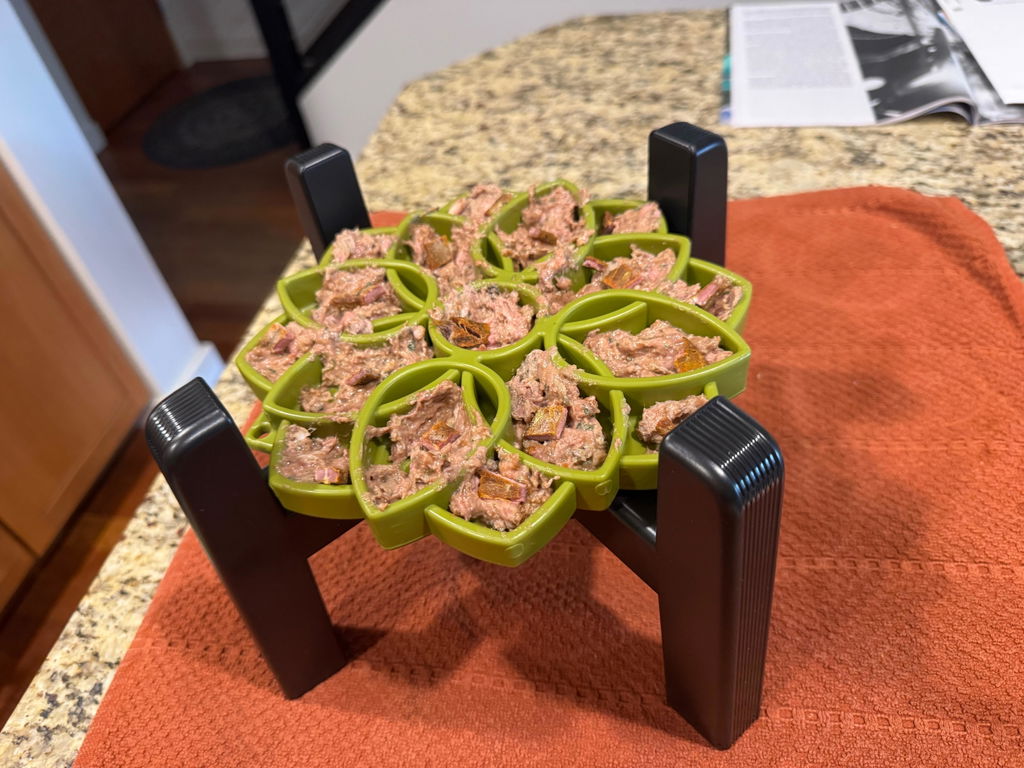
For senior dogs, choose Level 1 puzzles: single-step actions, wide compartments, and low physical effort. The SodaPup eTray works well as a gentle slow feeder: wet food or moistened kibble spread across the shallow tray requires focus and engagement without physical challenge. The eTray's shallow profile is also particularly well-suited to brachycephalic (flat-faced) senior dogs — breeds like Bulldogs, Pugs, and Boston Terriers — who may struggle to reach food at the bottom of a deep bowl comfortably, especially as any breathing or mobility issues become more pronounced with age. For dogs that need more of a challenge, the SodaPup eBowl uses raised patterns to slow down even the most enthusiastic eater, extending mealtime from thirty seconds to five or ten minutes and turning a routine meal into a small, satisfying daily "job."
4. Gentle Training Sessions
Old dogs absolutely can learn new tricks — and the learning process itself is enriching. Short training sessions (3–5 minutes) engage memory, attention, and the reward circuitry. For seniors: review known cues to maintain fluency, teach simple low-impact new behaviors, use high-value soft treats, and keep sessions short.
5. Calm Sensory Experiences
A slow "sniff walk" where your senior dog leads and stops to investigate every scent is one of the most complete enrichment experiences available — cognitively demanding, gently physical, and deeply satisfying to a dog's primary sense.
Enrichment to Avoid for Senior Dogs
Not every enrichment idea that works for a young, healthy dog translates well to a senior. Some activities that are perfectly safe for a two-year-old can be uncomfortable, risky, or simply frustrating for a dog in its later years. It's worth actively avoiding:
- High-impact jumping: Leaping for a toy, jumping on and off furniture repeatedly, or hard landings put unnecessary strain on aging joints and can worsen arthritis pain.
- Intense tug-of-war: Vigorous tugging can strain the neck, jaw, and spine, particularly in dogs with existing dental issues or musculoskeletal conditions.
- Overly difficult puzzle toys: A puzzle that's too advanced doesn't enrich a senior dog — it frustrates them. If a dog gives up quickly or seems agitated rather than engaged, the activity is working against its purpose.
- Long, high-speed fetch sessions: Repeated hard stops and sprints on pavement or hard ground can be tough on joints and cardiovascular stamina alike.
- Activities with no easy "win": Senior dogs, especially those with some cognitive decline, benefit from activities they can succeed at. Enrichment should build confidence, not create ongoing frustration.
The general rule of thumb: if an activity would leave a human senior citizen sore, breathless, or overwhelmed, it's probably not the right fit for a senior dog either.
Enrichment for Dogs with Canine Cognitive Dysfunction
If your dog has been diagnosed with CCD, enrichment needs to be especially gentle, predictable, and low-frustration. Principles for CCD enrichment:
- Maintain routine: Offer enrichment at the same time each day.
- Keep it simple: A smeared lick mat is often the ideal activity.
- Reduce novelty: Stick to familiar activities, familiar spaces, familiar flavors.
- Prioritize licking over problem-solving: The eMat used with a familiar, beloved filling is ideal.
- Supervise closely: Dogs with CCD may become confused during activities.
Enrichment for Arthritic Senior Dogs
Arthritis requires that enrichment be adapted to minimize joint stress while maximizing mental engagement:
- Use non-slip surfaces: Place the eMat or eTray on a yoga mat or rubber-backed rug.
- Elevate slightly when needed: A slightly raised platform for the lick mat reduces neck and shoulder strain.
- Choose lying-down enrichment: Activities your dog can engage with from a lying position are ideal for arthritic seniors.
- Avoid activities requiring jumping or running: Fetch and tug are likely off the menu for severe arthritis cases.
- Warm up before and after: A gentle massage before enrichment can loosen stiff joints.
Building a Senior Dog Enrichment Routine
A simple senior routine might include a slow sniff walk in the morning, a frozen lick mat session in the afternoon for some quiet downtime, a slow feeder at every meal, and a few minutes of easy training or a "find it" game in the evening. None of it needs to be elaborate — consistency and gentleness matter far more than intensity. Rotating through a few core activities across the week, rather than relying on just one, helps engage different senses and prevents any single activity from becoming stale.
Frequently Asked Questions: Senior Dog Enrichment
What is the best enrichment for senior dogs?
Lick mats and scent work are consistently recommended as the best enrichment for senior dogs. Both are low-impact, highly accessible, and cognitively engaging. The SodaPup eMat is specifically well-suited: flat, easy to lick from lying down, made from non-toxic USA materials. To compare mat options, see our guide to the best lick mat for dogs.
Can enrichment slow cognitive decline in dogs?
Studies on cognitive enrichment in aging animals show that mental stimulation maintains neuroplasticity and preserves cognitive reserve. While enrichment cannot reverse CCD once it develops, regular mental stimulation may slow the rate of decline and support quality of life.
How much enrichment should a senior dog get per day?
Two to four short sessions of 5–15 minutes each is a reasonable goal for most senior dogs — for example, a slow sniff walk, a few minutes of lick mat time, and a short scatter-feeding session. Watch your dog for signs of fatigue or frustration. Quality and consistency matter more than quantity.
Are lick mats good for senior dogs with dental problems?
Yes — lick mats are particularly well-suited for dogs with dental sensitivity because licking requires no hard chewing. This makes them especially well-suited to senior dogs with worn teeth, missing teeth, or sore gums, since there is no pressure placed on the jaw. Soft fillings like pumpkin puree, plain yogurt, or moistened kibble are easy on sore or worn teeth.
Why are slow feeders recommended for older dogs?
Slow feeders reduce the speed at which a dog eats, which lowers the risk of bloat (gastric dilatation-volvulus), a life-threatening condition that becomes more common as dogs age. Eating more slowly also eases digestion and can help manage weight, which is important for joint health in seniors.
My senior dog doesn't seem interested in toys anymore. Is enrichment still worth trying?
Absolutely. Loss of interest in toys is common with aging and may reflect pain, sensory changes, or cognitive shifts — not a loss of the desire for engagement. Lick mats and food-based enrichment often engage senior dogs who have lost interest in play-based activities.
What fillings are safe for senior dogs on lick mats?
Plain Greek yogurt, unseasoned pumpkin puree, mashed banana (in moderation), wet dog food, and low-sodium unseasoned meat baby food are all safe, soft options. Senior dogs may have dietary restrictions that warrant checking with your vet before introducing new foods.
Your senior dog has given you years of loyalty, presence, and love. The enrichment you offer now is one of the most meaningful ways to give something back. For the tools to make it easy, start with the eMat, built for exactly this stage of life.
Shop SodaPup enrichment products:
- SodaPup eMat Lick Mats — deep-texture, USA-made, suction cups available
- SodaPup eBowl Slow Feeders — reduce bloat risk, extend mealtime enrichment
All SodaPup products are made in the USA from food-safe, non-toxic materials.