Puppy Enrichment Guide: What to Do From 8 Weeks to 12 Months
Share
Enrichment for Puppies: A Week-by-Week Guide to Building a Happy, Confident Dog
Bringing home a new puppy is one of the most exciting — and overwhelming — experiences a dog owner can have. With potty training, crate training, and feeding schedules all competing for attention, enrichment can feel like one more thing on an already-long list. But here's what trainers and behaviorists want every new puppy parent to know: enrichment isn't an extra. It's the foundation.
The activities and experiences you give your puppy right now — during these early weeks and months — will shape their brain, their behavior, and their emotional resilience for the rest of their life. This guide will walk you through exactly what puppy enrichment is, why it matters so profoundly, and what's appropriate at each stage of development from 8 weeks to 12 months.
You've got this — and your puppy is counting on you.
What Is Puppy Enrichment — and Why Does It Matter So Much?
Enrichment is any activity that engages a dog's natural instincts — sniffing, licking, chewing, foraging, exploring — in a purposeful, positive way. For adult dogs, enrichment helps prevent boredom and anxiety. For puppies, it does something even more remarkable: it literally shapes the brain.
Between approximately 3 and 16 weeks of age, a puppy's brain is in a state of peak neuroplasticity — meaning neural circuits are forming, strengthening, and pruning at a rate that will never occur again in the dog's life. Research on the sensitive period in puppies confirms that experiences during this window have a disproportionately strong and lasting impact on future behavior compared to similar experiences later. The brain is, as one researcher puts it, "pure Play-Doh." Enriched sensory environments stimulate dendritic growth and prolong neuroplasticity, while deprived environments can leave neural circuits in an immature state — meaning puppies who experience positive novelty early develop stronger, more adaptable nervous systems.
The practical upshot: start enrichment early, keep it positive, and use this developmental window to your advantage. For more foundational ideas, visit the SodaPup Enrichment Hub.
Planning homemade meals for your puppy?
The free SodaPup Bowl Builder grades recipes against the stricter AAFCO Growth profile and sizes portions to your puppy's weight. Puppies are especially sensitive to calcium balance, so review the result with your vet.
Build my dog's bowl →How it worksThe Critical Socialization Window (8–16 Weeks)
The most important concept every new puppy owner needs to understand is the socialization window. Classic research by Scott and Fuller at the Jackson Laboratory identified the socialization period as approximately 3 to 12 weeks of age, with residual plasticity extending to about 16 weeks. This window gradually closes, meaning the same experiences become harder and harder to "install" as the puppy matures.
Most owners bring their puppy home at 8 weeks — right at the start of this critical phase. That means you have roughly 8 weeks of exceptional learning opportunity ahead of you.
What should you expose your puppy to during this time? Different surfaces (grass, tile, gravel), different sounds (traffic, vacuums, children), different people (hats, uniforms, beards), novel objects, gentle handling of paws and ears, and short positive alone-time to build independence.
The golden rule: pair every new exposure with something positive — a treat, calm praise, or a lick mat session. A frightening experience during this window can be imprinted just as powerfully as a positive one. For help picking one, see our guide to the best lick mat for dogs.
Puppy Enrichment Activities by Age: A Stage-by-Stage Guide
Puppy development isn't one-size-fits-all, but there are clear developmental stages that should guide what enrichment you offer — and when.
Stage 1: 8–12 Weeks — The Gentle Introduction
At 8 weeks, your puppy has just left their mother and littermates. Their attention span is roughly 2–3 minutes. Their coordination is still developing. Their baby teeth are sharp but their jaws are not yet strong, and those tiny teeth are still growing.
This is not the time for complex puzzles. This is the time for easy wins, sensory exploration, and positive associations.
What works at this stage:
- Lick mats — The SodaPup eMat is a perfect first enrichment tool. Its shallow, textured surface is easy for tiny muzzles to access, and licking naturally triggers endorphin release and reduces cortisol — ideal for crate introductions or any mildly stressful moment.
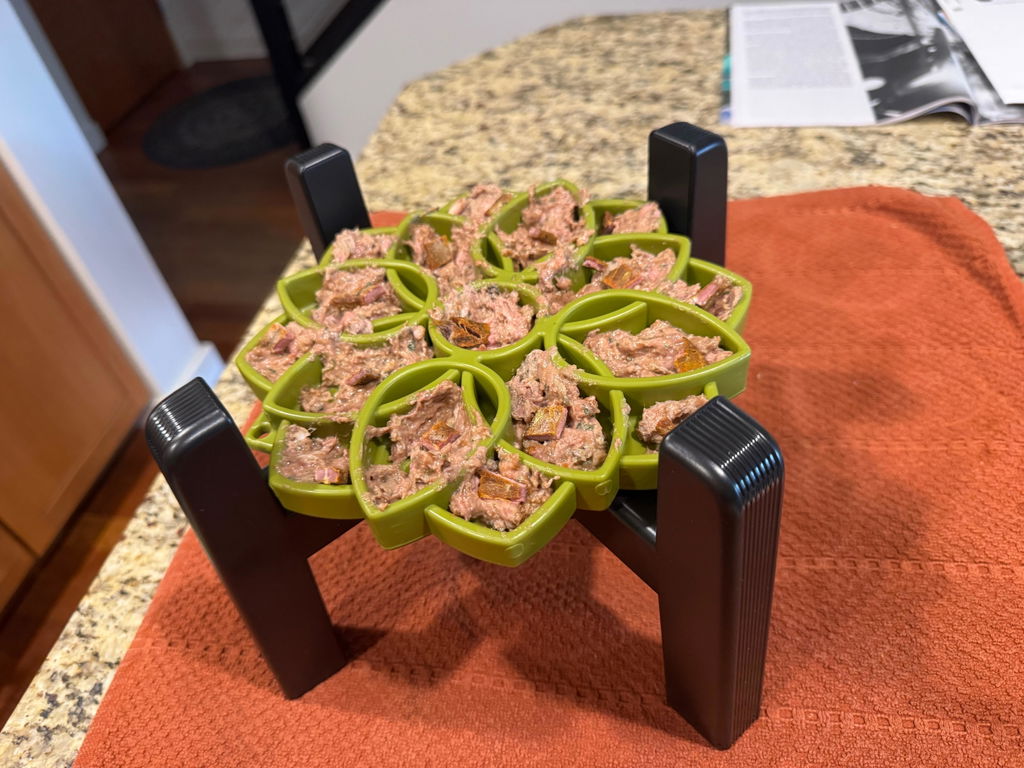
- Shallow slow feeders — The SodaPup eTray's shallow profile makes it perfect for small-breed puppies or young pups who can't reach the bottom of a standard bowl. Feed a portion of meals from the eTray to turn every mealtime into gentle mental engagement.
- Snuffle mats and foraging — Scatter kibble in a snuffle mat or folded towel. Keep sessions to 3–5 minutes.
- Sensory boxes — A shallow cardboard box with crinkled paper, a few treats, and textured objects builds novelty tolerance and confidence.
- Short training sessions — 2–3 minutes of sit, watch me, and name recognition tires puppies out more efficiently than physical exercise alone.
Chew toys at this stage: Baby teeth are delicate — avoid hard nylon, antlers, and bones. VCA Animal Hospitals warns against hard nylon for puppies due to tooth fracture risk. Soft rubber puppy chews, frozen washcloths, and lightly frozen stuffed rubber toys are appropriate. The eMat and eTray, used with soft spreads, are excellent teething companions.
Stage 2: 3–6 Months — The Teething Season
Between 3 and 6 months, your puppy is in the most intense teething phase. Baby teeth are falling out; adult teeth are coming in. Teething pain peaks during this window, and if you don't provide appropriate outlets, your puppy will find their own — usually your shoes. Sessions can now stretch to 5–10 minutes, and slightly more complex enrichment is appropriate.
What works at this stage:
- Frozen lick mats — Spread the eMat with plain Greek yogurt, mashed banana, or wet puppy food and freeze for 30–60 minutes. Cold soothes sore gums while extending the session naturally.
- Frozen eTray meals — Mix wet food with water, pour into the eTray, and freeze. A meal becomes a 15–20 minute calming activity with gum-soothing benefits.
- Beginner puzzle feeders — Level 1 feeders with obvious treat compartments are now appropriate. Coordination has improved enough to work through simple steps.
- Sniff walks — Let your puppy stop and smell everything. A 15-minute sniff walk is more tiring than a 30-minute march and promotes calm.
- Continued socialization exposure — The socialization window is closing. Keep introducing novelty positively and proactively.
Chew toys at this stage: Soft-to-medium rubber chews remain the gold standard. PetCareLab's "thumbnail test" is helpful — if your nail leaves an indentation in the chew, it's safe; if it's rock hard, skip it. Some puppy-specific nylon options labeled "gentle" may be appropriate for moderate chewers under supervision, but always choose materials with some flex.
Stage 3: 6–12 Months — The Adolescent Brain
Six months marks a significant shift. Most adult teeth are in and intense teething is winding down — but don't mistake that for "done with enrichment." This is the adolescent period, notorious for boundary-testing and high energy. The good news: enrichment capacity has grown dramatically, and your dog is ready for real challenges.
What works at this stage:
- Intermediate puzzle feeders — Level 2 puzzles with multiple steps, sliders, and flip compartments. Your dog is now capable of understanding sequences and patterns.
- Advanced eMat use — The eMat can now be used with thicker, more complex spreads, and you can start experimenting with the "pause before you get the mat" protocol to build impulse control.
- Scent work — Introduce simple nose work games. Hide a specific scent (anise, birch, or simply a loved toy) in one of several boxes and let your dog find it. This is one of the most cognitively demanding enrichment activities available — and dogs of all breeds love it.
- Trick training — Beyond the basics. Spin, roll over, bow, touch, place. Mental engagement through training builds focus and your relationship simultaneously.
- Chew rotation — Rotate 3–4 chews through the week to maintain novelty. Offer at least one rubber chew, one food-stuffed frozen toy, and one longer-duration option appropriate for your dog's chew style and size.
SodaPup's nylon chew toys are designed for adult and adolescent dogs with more developed jaws — not for puppies under 6 months. If you're considering nylon products for your older puppy, always check the age recommendation on the specific product and supervise use, especially with aggressive chewers.
Enrichment for Crate Training
The crate is one of the most valuable tools in a puppy owner's kit — but only if your puppy feels safe inside it. The principle: the crate should always predict good things. Before your puppy even enters, good things should already be happening.
The lick mat protocol for crate training:
- Smear the eMat with a soft, high-value spread (plain peanut butter with no xylitol, plain yogurt, or mashed sweet potato).
- Place the mat inside the crate with the door open. Let your puppy walk in and start licking on their own.
- While they're licking, gently close the door. Stay nearby.
- Open the door again before the mat is finished — this prevents the crate door from becoming associated with "the good stuff ends."
- Build duration gradually, following the Three D's: Duration first, Distance second, Distraction last.
For longer crate time, freeze the eMat or eTray in advance to extend the session naturally. Professional trainers recommend starting with seconds, not minutes — build duration only as fast as your puppy stays genuinely comfortable. Rotate flavors to maintain novelty and keep pre-frozen mats in the freezer so you're always prepared.
Enrichment and Resource Guarding Prevention
Resource guarding is a natural canine behavior, but enrichment used thoughtfully can reduce the likelihood of it becoming a serious problem. Hand-feed portions of meals regularly so a human approaching food predicts good things. Practice trade-up games: when your puppy has something, offer something of higher value in exchange — never just take things away. Provide separate lick mats in separate areas for multi-dog households. When your puppy is on the eMat, approach and add more food rather than removing it — your presence should predict abundance, not scarcity. If you notice significant guarding, consult a certified trainer or veterinary behaviorist early.
Frequently Asked Questions: Enrichment for Puppies
When can I start enrichment with my puppy?
Day one at home. At 8 weeks, keep activities simple: a smear of yogurt on the eMat, kibble scattered in a folded towel, or a short sensory exploration with novel textures. The socialization window is already open when your puppy arrives, and positive novelty exposure has a lasting impact on brain development. Short, successful sessions matter far more than long, complicated ones.
Are lick mats safe for puppies?
Yes — lick mats are one of the safest and most beneficial enrichment tools you can offer a puppy. Vets widely recommend them as a calming, mentally stimulating activity. The act of licking naturally releases endorphins and can reduce cortisol. For puppies, use shallow-profile lick mats like the SodaPup eMat or eTray, which are easy for small muzzles to access. Always supervise first uses to confirm your puppy is licking, not chewing the mat itself, and use age-appropriate food fillings.
How do I use a lick mat for crate training?
Place a freshly smeared (or lightly frozen) eMat inside the crate before asking your puppy to enter. Let them walk in on their own to start licking with the door open. Once they're engaged, gently close the door and stay close. Open it again before the mat is finished. Repeat this daily, gradually increasing the time the door stays closed. The goal is that the crate predicts the lick mat — so your puppy actively wants to go in. Frozen mats extend the session naturally and are especially useful for longer crate time.
What enrichment is right for a 10-week-old puppy?
At 10 weeks, keep enrichment simple and positive. The eMat and eTray are ideal — both provide gentle licking stimulation without requiring complex coordination. Scatter feeding, sensory exploration boxes, and short 2–3 minute training sessions are all appropriate. Avoid high-difficulty puzzles or hard chew toys. The goal at this age is building confidence, positive associations, and tolerance for novelty — not challenging your puppy beyond their developmental capacity.
How long should enrichment sessions be for puppies?
Short. At 8–12 weeks, aim for 2–3 minutes. By 3–6 months, 5–10 minutes is appropriate. By 6–12 months, 10–20 minutes works well. Always end on success — before your puppy loses interest or gets frustrated. Two short daily sessions beat one long session that ends in overwhelm.
Can puppies use nylon chew toys?
Not all nylon toys are appropriate for puppies. Hard nylon designed for adult dogs can fracture developing teeth — VCA Animal Hospitals specifically warns against hard nylon for puppies. SodaPup's nylon chews are intended for adult and strong adolescent dogs. For puppies, the eMat and eTray are the right starting points — safe from day one, accessible for all sizes, and built to grow with your dog. When evaluating any chew, apply the thumbnail test: if your nail leaves no indentation, it's too hard for a puppy.
Ready to build your puppy's enrichment toolkit? Start with the SodaPup Enrichment Hub for product guides, filling ideas, and age-by-age enrichment plans. The eMat and eTray are perfect first steps — and your puppy's brain will thank you for every positive experience you give them right now.
Ready to put this guide into practice? Shop our puppy enrichment collection for age-appropriate toys sized and textured for growing jaws.
Shop SodaPup enrichment products:
- SodaPup eMat Lick Mats — small sizes ideal for puppy jaws, USA-made and food-safe
All SodaPup products are made in the USA from food-safe, non-toxic materials.