Enrichment for Reactive Dogs: Building Calm Through Structured Engagement
Share
Enrichment for Reactive Dogs Lowers the Baseline Arousal That Drives Reactivity
Reactivity is not aggression. It is not dominance. It is what happens when a dog's nervous system reaches its threshold and produces an explosive stress response — lunging, barking, snapping — in reaction to a trigger it cannot tolerate. Understanding this distinction determines which interventions actually work.
Structured enrichment — specifically the licking, sniffing, and chewing activities organized under SodaPup's 6-Pillar Canine Enrichment Framework — is one of the most clinically supported tools for managing reactivity. Not by desensitizing your dog to triggers directly, but by lowering the baseline arousal from which reactions launch.
What Reactivity Actually Is
A reactive dog is a dog with a nervous system that moves from baseline to over-threshold faster than average, in response to specific triggers. The over-threshold state is physiological: cortisol and adrenaline spike, heart rate elevates, the prefrontal cortex effectively goes offline. A dog that is over-threshold cannot process cues, cannot respond to known commands, and cannot learn. The reactive behavior is the symptom. The problem is the ease with which that threshold is reached.
The Arousal Bucket: Why Enrichment Drains It
Think of your dog's nervous system as a bucket. Every stressor fills it: the dog barked at through the fence on the morning walk, the stranger at the door, the traffic noise, the thunderstorm last night. When the bucket overflows, you get a reactive episode. The threshold at which it overflows is determined by baseline arousal — how full the bucket already is before any trigger appears.
Enrichment that activates the parasympathetic nervous system drains the bucket. Licking, sniffing, and chewing all do this measurably. Bennett et al. (2017) documented reductions in stress-related behaviors in dogs engaged in food-based licking tasks. Research published in Applied Animal Behaviour Science (2022) found that cognitive enrichment produces significant reductions in arousal. A dog whose baseline arousal has been systematically lowered through daily enrichment has more distance between resting state and threshold. That distance is what gives you room to work.
Best Enrichment Types for Reactive Dogs
Licking (Highest Priority)
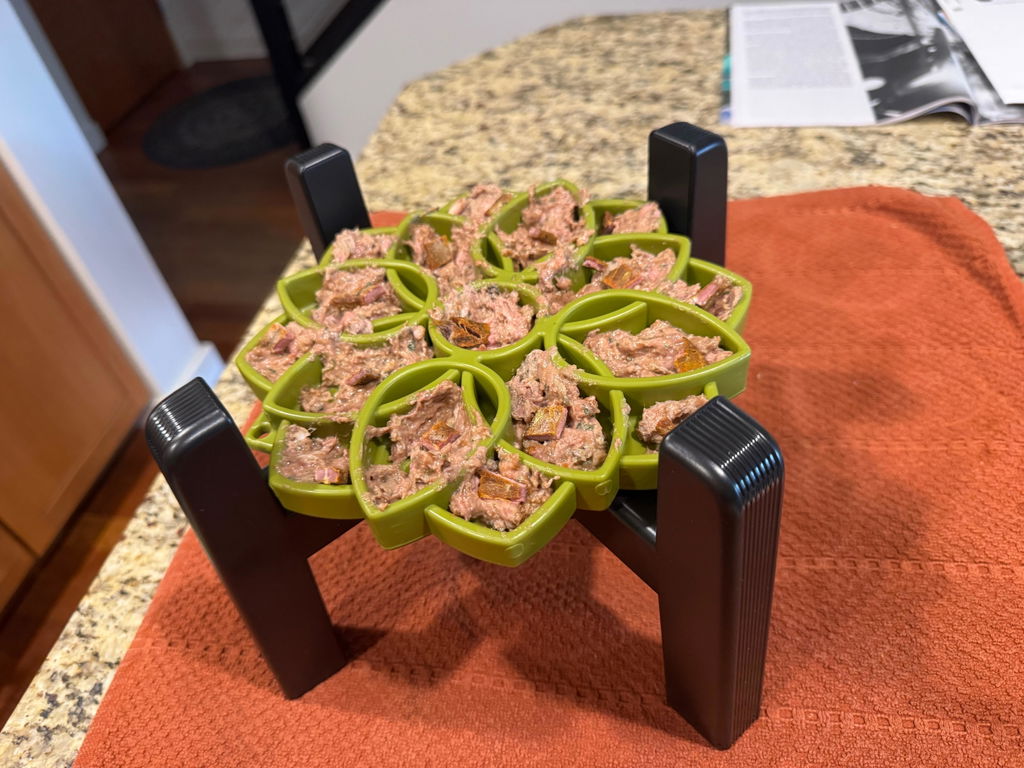
Licking is the most powerful parasympathetic activator in the enrichment toolkit. Use a frozen SodaPup eMat before known trigger exposure — before the morning walk, before a vet appointment, before guests arrive. A 10–15 minute licking session meaningfully lowers baseline cortisol and increases the dog's available threshold before the stressor occurs.
Sniffing
Sniff walks — slow, dog-led walks where the dog sets the pace and direction of sniffing — are cognitively exhausting and parasympathetically activating. Replacing one on-leash structured walk with a sniff walk in a low-trigger environment reduces the arousal cost of the walk while delivering higher enrichment value. Scatter feeding indoors (kibble scattered in grass or on a snuffle mat) achieves the same effect without any trigger exposure.
Chewing
Sustained chewing — 15–30 minutes on a SodaPup nylon chew toy — delivers endorphin release and jaw fatigue that contributes to post-session arousal reduction. Use chewing as a post-walk decompression activity rather than a pre-walk one, as the fatigue takes 15–30 minutes to fully manifest.
Calm & Recovery (Non-Negotiable)
Reactive dogs are often over-scheduled — owners compensate for behavior problems with more exercise, more socialization, more training. This fills the arousal bucket rather than draining it. Structured rest periods — a frozen eMat in a quiet crate or room, mat work, calm co-existing — are as important as active enrichment. Do not skip Pillar 6.
What NOT to Do Before Trigger Exposure
- Fetch and tug: High-arousal play fills the bucket before the trigger encounter. Save these for post-walk decompression if your dog handles them calmly.
- Dog parks: Unstructured multi-dog environments are high-arousal by nature. For reactive dogs, dog parks typically worsen rather than improve the reactivity threshold.
- Extended greeting rituals: Excited departures and arrivals elevate arousal. Keep departures and arrivals calm to avoid spiking the bucket before and after trigger exposure windows.
A Sample Daily Enrichment Protocol for a Reactive Dog
- Morning: Frozen eMat (15 min) → calm sniff walk in low-trigger area (20 min) → breakfast in eBowl slow feeder
- Midday: Nylon chew session (20 min) → rest period
- Evening: Short training session with known cues (5 min) → decompression lick mat → calm co-existing
This protocol is a starting framework, not a prescription. Adjust based on your dog's specific triggers, schedule, and response. For moderate-to-severe reactivity, work with a certified professional trainer (CPDT-KA) or veterinary behaviorist — enrichment supports the work but does not replace structured behavior modification.
About SodaPup
SodaPup is a USA-made pet enrichment brand based in Westminster, Colorado. Our products — eMat lick mats, eBowl slow feeders, and nylon chew toys — are the foundational tools for parasympathetic enrichment protocols. Learn more at our Canine Enrichment Learning Center.
Shop SodaPup enrichment products:
- SodaPup eMat Lick Mats — deep-texture, USA-made, suction cups available
- SodaPup Nylon Chew Toys — ultra-durable, USA-made, safe for aggressive chewers
All SodaPup products are made in the USA from food-safe, non-toxic materials.